

Three Things
On keeping winter hours, our new favorite picture book, and a gentle podcast for kids.


Hello, loves. I hope you’re doing okay.
Danielle Cadet, in an essay for The Cut, spoke to the whiplash that I think many of us, especially parents, may be feeling lately, as we turn from our screens to whatever task is next at hand then back to our screens again. “Mothers are pulling dinner out of the oven, navigating after-school schedules, helping with homework, signing up for summer camp (yes, in January), and smiling through it all while a war rages inside our own brains,” she writes. “We read a horrifying headline one minute and a fairy tale the next.”
When I read this, I thought back on these last seven years of motherhood, and thought, yes, this is the work of parenting — tending to our children while also tending to the world we’re making for them.
Cadet finds some hope in this thought, too:
I don’t have a solution. I don’t know how to raise a generation of children who feel motivated to build despite the fact that the world is burning around them. But perhaps the best thing for these kids is that they’re being raised by a group of parents who have had to hold heartbreak in one hand and hope in the other. Maybe our emotional whiplash has made us more equipped to raise empathetic humans who are bold and, more important, who are just. What I know for sure is I can’t look away.
Neither can I look away, and I suspect that’s true of you, too. I’ve gathered a few links in response to the ongoing crisis in Minnesota. I’m sharing them, below, and would love it if you’d also share any other resources you’ve found helpful.
I’d also like to offer three things I’m reading and listening to…
A picture book that reminds us what it really means to be human
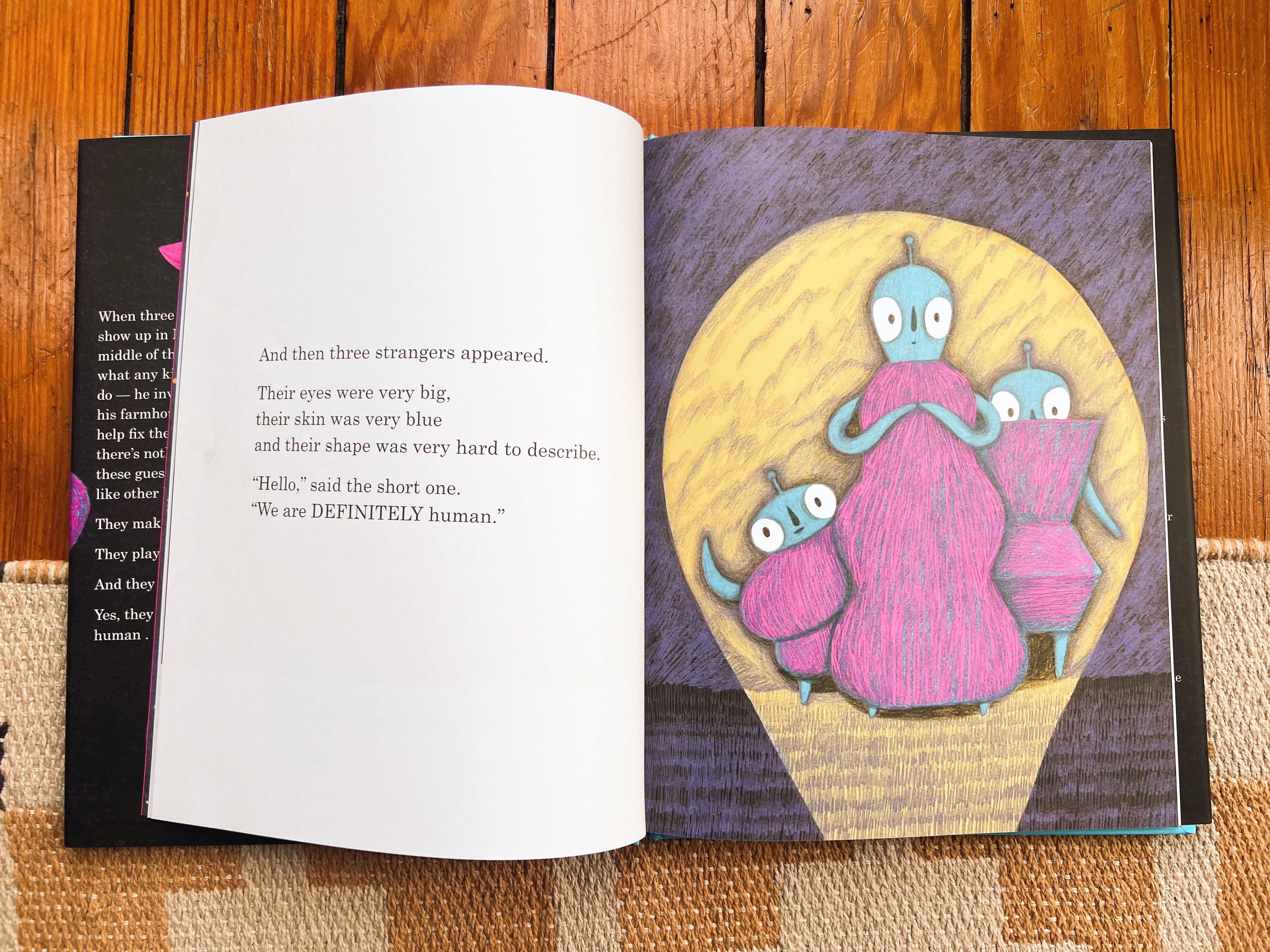
This year, during our annual holiday book exchange, a dear friend, who happens to live in Minneapolis, sent my kids the picture book We Are Definitely Human by X. Fang. When a spaceship crash lands in a farmer’s field, a trio of aliens clumsily insist, to comic effect, that they are definitely human. (This always elicits a giggle from my kids.) The farmer offers these visitors a place to stay for the night and, the next day, takes them to the hardware store for supplies to fix their spaceship. Many townspeople lend a helping hand, which leads to a party with food and music and dancing.
In the end, the aliens blast off into space, taking with them what they’ve learned about being human. As they continue their intergalactic journey they “remember kind humans and do what kind humans do — offer to help those in need.”
It’s a lighthearted story, but lately, when we read it, my thoughts keep drifting to my friend, to the many ways her friends and neighbors have organized to support and protect their community. Confronted with cruelty and dehumanization, the people of Minnesota are insisting upon our shared humanity, they are showing their children, and the rest of the country, what kind humans do.
Mary Oliver on darkness, hope, and interconnectedness in “Winter Hours”
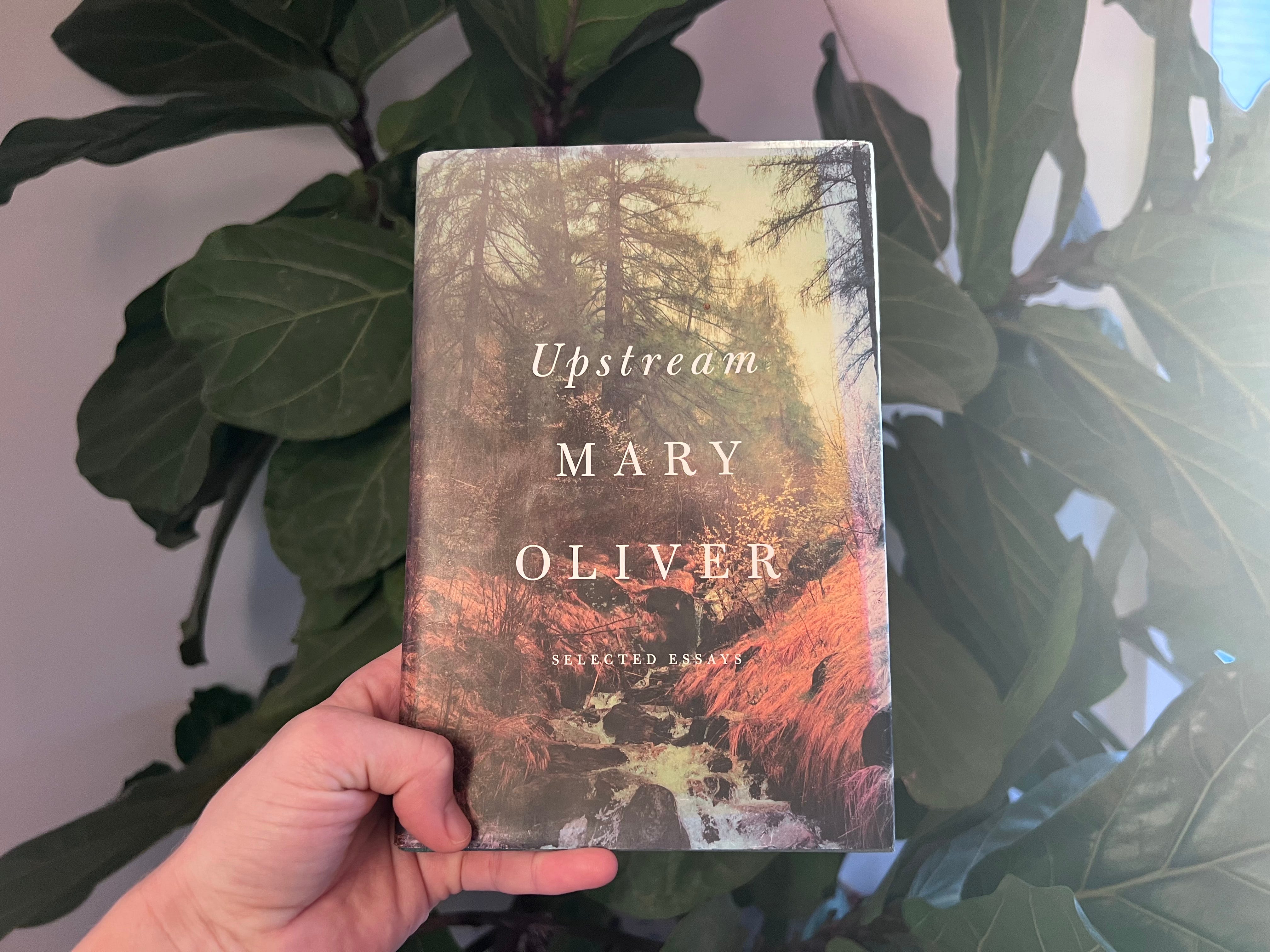
Where I live, the light is gradually returning with each day lengthening ever so slightly, and yet we are still in the thick of what we, in the Pacific Northwest, call The Big Dark. For solace, each January, I re-read Mary Oliver’s essay “Winter Hours.”
I’d like to share two passages that spoke to me, this year especially:
In the winter I am writing about, there was much darkness. Darkness of nature, darkness of event, darkness of the spirit. The sprawling darkness of not knowing. We speak of the light of reason. I would speak here of the darkness of the world, and the light of _____. But I don’t know what to call it. Maybe hope. Maybe faith, but not a shaped faith — only, say, a gesture, or a continuum of gestures. But probably it is closer to hope, that is more active, and far messier than faith must be. Faith, as I imagine it, is tensile, and cool, and has no need of words. Hope, I know, is a fighter and a screamer.
I love this muscular characterization of hope. Later on, Oliver concludes the essay with a stunning praise song to our interconnectedness:
I would say that there exist a thousand unbreakable links between each of us and everything else, and that our dignity and our chances are one. The farthest star and the mud at our feet are a family; and there is no decency or sense in honoring one thing, or a few things, and then closing the list. The pine tree, the leopard, the Platte River, and ourselves — we are at risk together, or we are on our way to a sustainable world together. We are each other’s destiny.
Recognizing and repairing our relationships to each other and to the more-than human world feels as urgent and necessary as ever.
A gentle podcast to listen to with kids
Whenever I’m hoping for a few moments of calm in the kitchen, I like to turn on a children’s podcast. Usually this background programming is entertaining enough to entice my children to remain seated at the table long enough to eat a snack or scribble a drawing while I make dinner. Our go-to is Brains On! but Atmos recently posted about a new podcast called Hello Earthling.
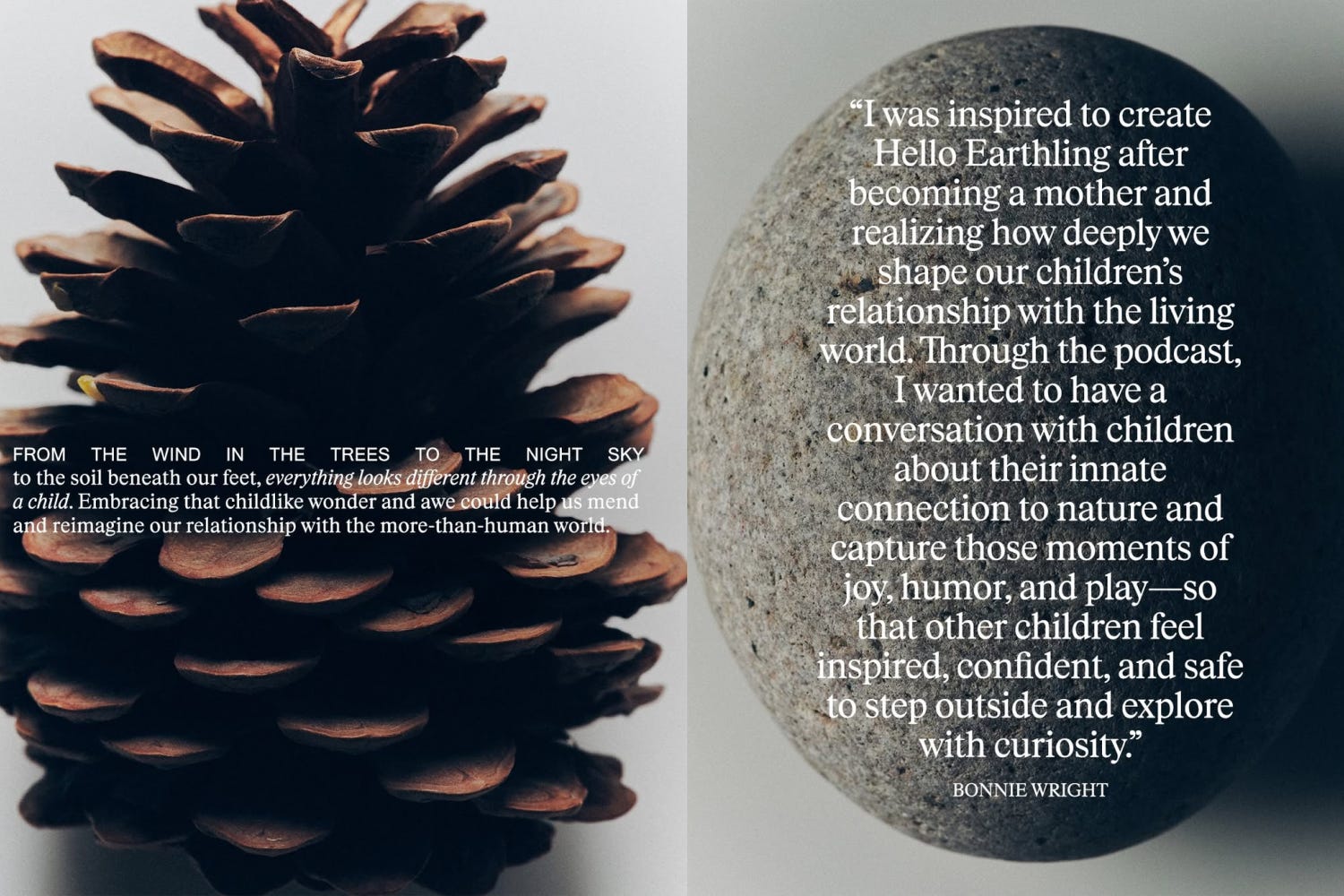
In short, fifteen-minute episodes centered on a topic, like things with wings or among the trees, host Bonnie Wright invites children from around the world to discuss their relationship with nature.
Each episode opens with a (much-needed) invitation to take a deep breath as well as Wright’s delightfully capacious definition of what it means to be an earthling:
What is an earthling? An earthling is any living being that lives here on planet Earth. That means you, me, the birds in the sky, the fish in the sea, the buzzing bees, the rustling trees, and every little creature in between.
In the episode we listened to most recently, I found myself trying to answer a question Wright posed to a child she was interviewing: “When did you last climb a tree?”
I honestly don’t remember, do you?
A couple of resources:
In addition to supporting Minnesota-based mutual aid organizations, like the Roosevelt High School Student Ambassadors and Neighbors Helping Neighbors (h/t to Anne Helen Petersen for these recs), many of us are also donating to organizations like the Immigrant Law Center of Minnesota or the Immigrant Rapid Response Fund. I’m looking to Jess Craven’s newsletter Chop Wood, Carry Water and the 5 Calls app for scripts to use when contacting my representatives. Elizabeth, a.k.a. TheKidLitMama, shared a list of books to support children through scary news, family separation, and violence. Britt Hawthorne is offering an age-based guide for talking to children about immigration enforcement in efforts to provide accurate information without fear-based language, all while centering humanity, safety, and care.
Closer to home, I’m also donating to a local mutual aid organization and following updates from our state’s immigrant solidarity network. As Rabbi Jessica Rosenberg wrote in Ann Friedman’s newsletter, “Wherever you are, gather with your block or neighborhood. Talk about what’s happening here. Make a plan for when it happens there.”
A few more things I’m reading:
“The term, of course, is meant to be derisive, to undercut the hard, sophisticated, and coordinated work that women are doing to provide a social safety net where there is otherwise none. Because, again, it is primarily women who do this work — women who organize and plan and stand in the gap between ruin and hope.” — Lyz Lenz on the Minnesota mothers delivering groceries to their neighbors, keeping watch outside elementary schools, and forming rapid response groups in ‘Organized gangs of wine moms’
“You are feeling something deeply, and it may or not yet be pulling you in a clear direction, but in either case it is a gorgeous reminder: You are human. And you are reacting to horrors being rained down on other human beings. You ache for them and rage for them and feel incapacitated on their behalf because that is what human beings do when we don’t turn off the part of us that knows we are made for more than cruelty.” — Garrett Bucks in What a rage-filled heart, an exhausted heart, a terrified heart, and a grieving heart have in common
“I started to dream of a future where we fundamentally accept that humans exist in an infinite variety of forms. That families and parents and kids and friends and neighbors and strangers move through the world in all sorts of ways, our minds work in all sorts of ways, our bodies look and work in all sorts of ways, we approach relationships in all sorts of ways, we talk in all sorts of ways. I want this to be so obvious that explaining it is a snooze fest. I want them to live in a world where asking someone to explain their most noticeable difference isn’t nearly as interesting as experiencing the actual person in front of us — How do they see the world? What makes them laugh? What fires them up? What new kinds of play might you discover together?” — memoirist and disability justice advocate Rebekah Taussig’s reflections on mothering and the power of imagination, interviewed by Courtney Martin in Sometimes teaching is embodying a boundary
(Opening photo by Dana Critchlow / Unsplash.)

The last couple of winters I've read A Winter Book by Tove Jansson for the same reasons as your Mary Oliver selection! At least we are adding back minutes each day now.