

Five Fascinating Books that Shifted How I Think About Time
By the way, how are we feeling about Daylight Savings and that hour of lost sleep?


Hi! How are you?
I’ve been fascinated by time, as a concept, ever since a childhood babysitter explained to me that kids and adults experience the passage of time differently. A year feels, like, soooo long when you’re 10, she said, since it’s literally one-tenth of your life. But when you’re 40, a year represents a much smaller fraction.
Then, in middle school, I read Madeleine L’Engle’s A Wrinkle in Time and spent far too long puzzling over this illustration of a tesseract, or a wrinkle in space-time that allows for time travel:
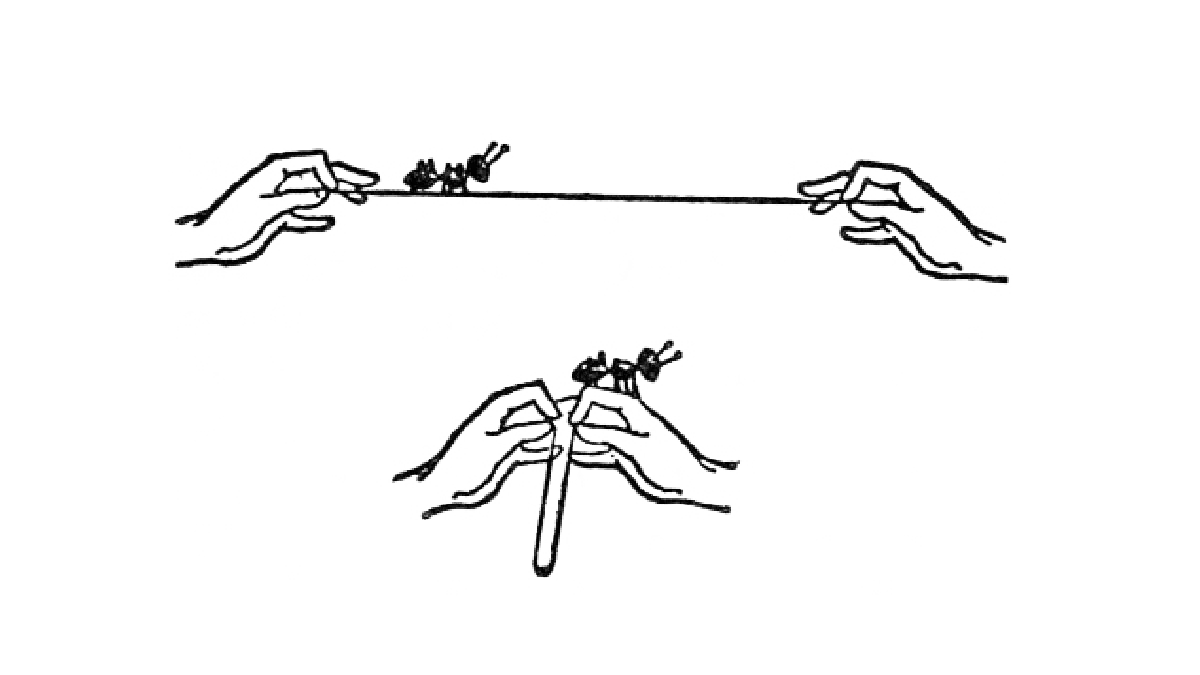
My thinking about time was further complicated when I learned that the Greeks had two words for time: chronos, which is measured quantitatively and which L’Engle describes as “ordinary, wrist-watch, alarm-clock time” and kairos, which is measured qualitatively and can be understood as “real time” or “the right time.”
In her book, Walking on Water, L’Engle writes of kairos as something like entering a state of flow:
In kairos we are completely unself-conscious and yet paradoxically far more real than we can ever be when we are constantly checking our watches for chronological time. The saint in contemplation, lost (discovered) to self in the mind of God is in kairos. The artist at work is in kairos. The child at play, totally thrown outside himself in the game, be it building a sandcastle or making a daisy chain, is in kairos.
Theologians sometimes speak of kairos as “God’s time” or “the eternal breaking into the temporal” and rhetoricians have theorized about kairos and its usefulness for crafting calls to action that appeal to time, as Martin Luther King, Jr., does when he refers to the “fierce urgency of the now.”
And yet, it’s possible that nothing has affected my conception of time more than becoming a mother, something I explore in an essay called Watching the Clock, about teaching my daughter to tell time even as the looming threat of the climate clock ticks on (a version of this essay appears in my forthcoming book).
Time, I’m realizing, is not just a concept to theorize but something to feel in the steady pulse of the blood that is even now pumping through our bodies. Our understanding of time shapes the moments we share with each other and our relationship to the planet and even to life itself.
Here, I’m sharing five nonfiction books that have radically shifted how I think about time…
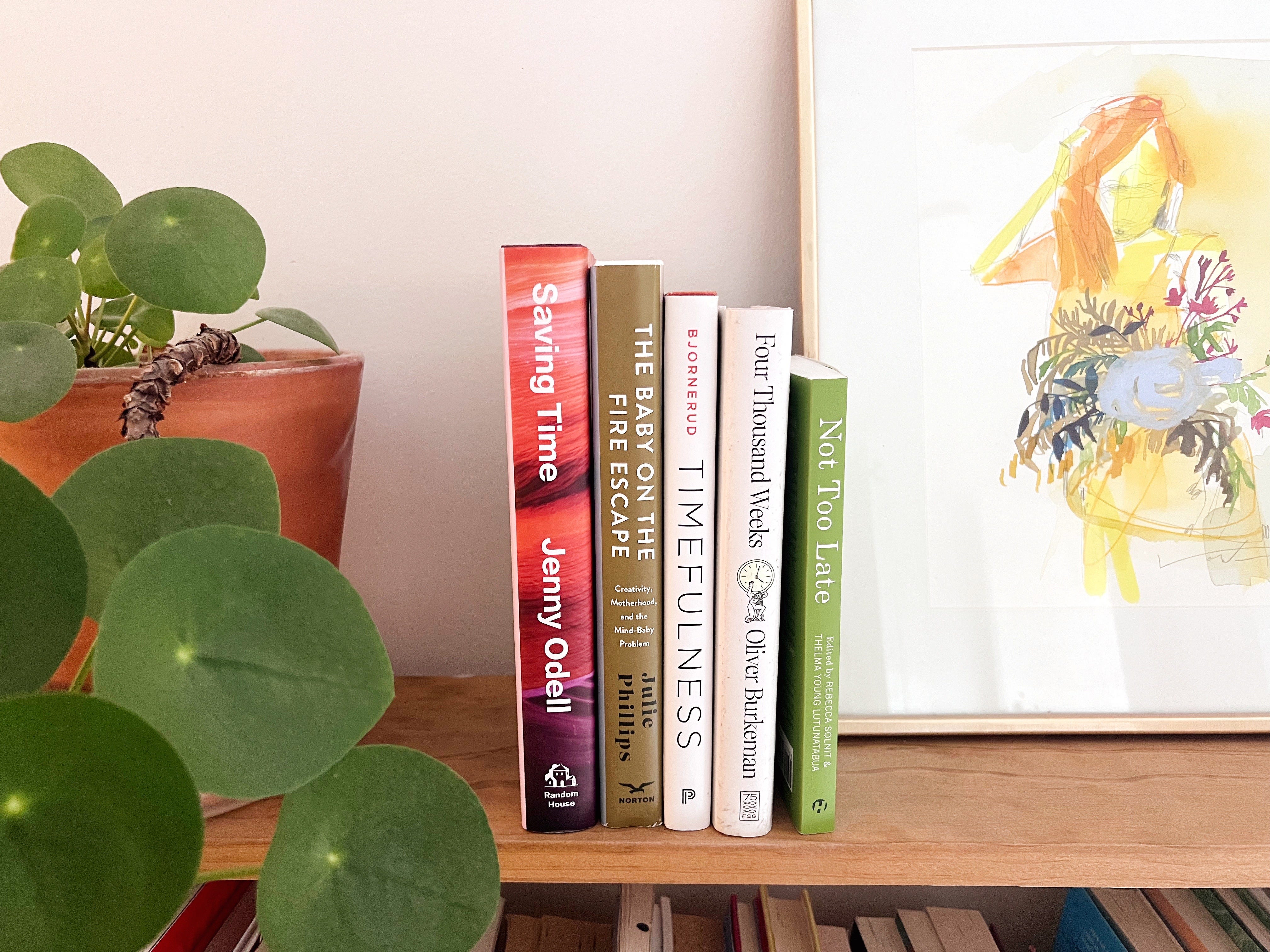
Saving Time: Discovering a Life Beyond Productivity Culture by Jenny Odell
After reading Jenny Odell’s remarkably prescient How to Do Nothing — which she began writing after Trump’s first election win and published at the peak of the pandemic — about the attention economy and how digital technologies shape our inner landscapes, I was willing to follow her writing anywhere.
In Saving Time, Odell turns the full force of her multi-disciplinary research to interrogating time, which makes sense as a follow up to her debut, since attention and how we experience time are, in many ways, linked.
Among the many varieties of time Odell considers are “the stretchy quality of waiting and desire, the way the present may suddenly feel marbled with childhood memory, the slow but sure procession of a pregnancy, or the time it takes to heal from injuries, physical or emotional.”
Later in the book, she confronts the climate nihilism that pervades our cultural mood, writing, “There is a lonely absurdity in the idea of racing against the clock at the end of time, as evidence in a headline by the parody site Reductress: ‘Woman Waiting for Evidence That World Will Still Exist in 2050 Before She Starts Working Toward Goals.’”
In her conclusion, she writes movingly of a friend, the artist Sofía Córdova, who practiced cuarentena after giving birth, a Latin American tradition in which a new mother rests at home with her baby for forty days. Birth, her friend said, was “one possible portal or escape hatch from the flow of our shared concept of time.”
I felt this in my bones. And Córdova’s observation, too, about how birth is a before-and-after story: “[A]s you and this new being are rapidly moving to a new understanding of self and world, coupled with the specificity, disorientation, and uncanny nature of this fleeting moment, make for some pretty hard edges when it comes to defining this time against everything that has happened before or since.”
It was the Alice Neel painting on the cover that first drew me to biographer Julie Phillips’s The Baby on the Fire Escape. At the time, I was several months postpartum with our second child and struggling with creative self-doubt. I couldn’t figure out whether there was a place in my life for a meaningful writing practice. Enter Phillips’s examination of how twentieth-century artists, writers, and activists — like Ursula K. Le Guin, Alice Neel, and Audre Lorde — held together the demands of mothering and creative work.
When I first read about what Phillips calls “maternal time,” it felt like a revelation. While the logistics varied greatly, the one thing all the mothers Phillips profiles in the book needed was time. She concludes, “They needed hours to work; a fair division of days; a way to game capitalism’s cruel time-money equations. They lived for moments of insight; learned from moments of undoing; watched the clock that holds maternity and creativity in productive tension.”
And lest mothers despair of such time scarcity, Phillips also thoughtfully honors the work of care and how it shapes our relationships to time, writing: “The work of care alters time, linking humans to the past and future, tying us to the present, insisting on simultaneity, allowing moments of selfhood, committing us to nostalgia and futurity.”
Timefulness: How Thinking Like a Geologist Can Help Save the World by Marcia Bjornerud
Did you know that the length of time a drop of water typically stays in the Earth’s atmosphere is about nine days, or that we are now three-quarters of the way through the planet’s habitable period? Timefulness is geologist Marcia Bjornerud’s argument for adopting what she calls a polytemporal worldview — one that recognizes that planetary processes move at various rates of change, some fast, some slow. It’s also her, dare I say thrilling, account of how geochronologists pieced together the story of Earth’s past. “Fathoming deep time,” she writes, “is arguably geology’s single greatest contribution to humanity.”
If reading a book about timescales and geologic processes sounds boring, it’s a criticism Bjornerud counters in her opening chapter, writing, “As a species, we have a childlike disinterest and partial disbelief in the time before our appearance on Earth. With no appetite for stories lacking human protagonists, many people simply can’t be bothered with natural history.”
Not only is such anthropocentric thinking myopic, in her view, it’s a downright dangerous form of ignorance. “Like inexperienced but overconfident drivers,” writes Bjornerud, “We accelerate into landscapes and ecosystems with no sense of their long-established traffic patterns, and then react with surprise and indignation when we face the penalties for ignoring natural laws.”
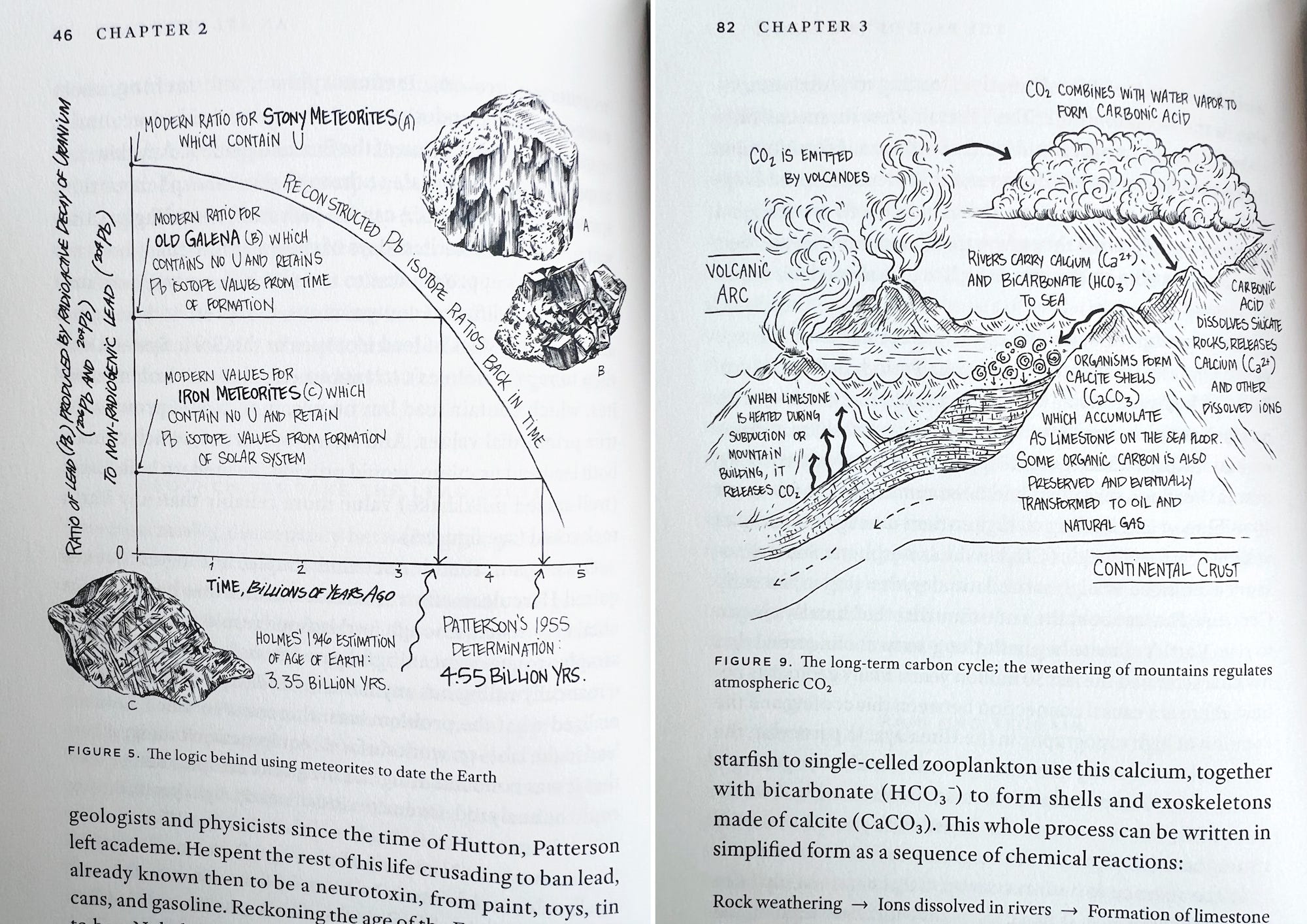
Timefulness is an exquisite example of what the best science writing can do. Whether explaining how scientists analyzed meteorites to date the Earth or how the fossil record can be used to estimate rates of extinction, Bjornerud’s prose is gorgeously readable and makes the history of geology both understandable and meaningfully relevant. Her book offers an invitation to think more deeply and hopefully about our own mortality and to arrive at a newfound appreciation for our place in the story of the planet’s long history.
Bjornerud writes, “[I]f the 4.5 billion-year story of the Earth is scaled to a 24-hour day, all of human history would transpire in the last fraction of a second before midnight.” This may be true, allows Bjornerud, yet she cautions that this metaphor minimizes the impact that humanity can still make in a relatively short amount of time. Ultimately, she concludes, “[T]his is a wrongheaded, and even irresponsible way to understand our place in Time.”
Four Thousand Weeks: Time Management for Mortals by Oliver Burkeman
Here is where I confess that my fascination with time has never quite extended to time management. I haven’t read Getting Things Done or The 4-Hour Work Week or Slow Productivity. Of these, I remain blissfully unaware.
And yet, I was drawn to Oliver Burkeman’s Four Thousand Weeks at a time when I was desperate to get a handle on productivity, both personally and professionally. In the months when I was juggling work and parenting while also writing to meet my book deadline, I found his philosophical take on time management to be a balm. My copy is dog-earred and underlined in a manner that is almost devotional.
And while, much of my own writing is an argument for practicing hope, I found Burkeman’s afterword, titled “Beyond Hope,” to be, perhaps counterintuitively, hopeful.
“The world is already broken. And what’s true of the state of civilization is equally true of your life,” he writes. But, this dismal revelation, needn’t be cause for despair, but can instead be energizing, even liberating. “Once you no longer need to convince yourself that the world isn’t filled with uncertainty and tragedy, you’re free to focus on doing what you can to help,” concludes Burkeman. “And once you no longer need to convince yourself that you’ll do everything that needs doing, you’re free to focus on doing a few things that count.”
Finally, the book also contains some surprisingly lovely insights about parenting. Burkeman quotes nineteenth-century Russian philosopher Alexander Herzen, who wrote: “Because children grow up, we think a child’s purpose is to grow up. But a child’s purpose is to be a child. Nature doesn’t distain what only lives for a day. It pours the whole of itself into each moment . . . Life’s bounty is in its flow. Later is too late.”
Not Too Late: Changing the Climate Story from Despair to Possibility by Rebecca Solnit and Thelma Young Lutunatabua
If you read just one book about timekeeping and the climate crisis, let it be Not Too Late, a wide-ranging anthology with contributions from scientists and activists that take the form of interviews, essays, and even a love letter from the clean energy future, a future in which we’ve successfully decarbonized and averted the worst climate outcomes.
“There is a ticking clock of terror that grips so many who learn about the horrifying direction we are rushing toward,” writes editor Thelma Young Lutunatabua. “The Italian physicist Carlo Rovelli, in his book The Order of Time, notes that the standardization of our clocks is a modern occurrence, that traditionally time was conceived by ‘counting the ways in which things change.’ It’s no wonder, then, given how swiftly the planet is shifting that this generation is heavy with anxiety with the understanding that we are running out of days to halt the climate crisis.”
Yet, throughout the book, the resounding message is that we have the solutions we need to address the climate crisis and there is still yet time to do what needs to be done.
In her essay “Difficult Is Not the Same as Impossible,” editor Rebecca Solnit writes, “It is late. We are deep in an emergency. But it is not too late, because the emergency is not over. The outcome is not decided. We are deciding it now. The longer we wait to act, the more limited the options, but scientists tell us there are good options and great urgency to embrace them while we can.”
On that note, Solnit has new book out this month called, The Beginning Comes After the End: Notes on Change. I can’t wait to, ahem, find the time to read it.
If you’ve read any of these books about time, I’d love to know what you think. And, what other titles would you add to this list?
An excerpt of a poem for you:

A few more things I’m reading:
“I was raised to believe parenthood was an inevitability — the adults in my life, the Evangelical church we worshipped at, and the conservative nature of Puerto Rican society we’ve lived inside made sure of it. As a teen, I’d talk about the day I’d become a mother and how I’d have four kids . . . Hanging out in the living room, I listed many of the reasons holding me back, from the ones out of my control (the general state of the world being scary, obviously) to the truly dumb (I like sleeping in on the weekends, sue me!) and the deeply existential (What if I’m an awful parent?).” — Andrea González-Ramírez in Maybe Knowing Too Much About Motherhood Has Ruined Me
“Organizing by ordinary people to shelter immigrants in private homes represents an emerging, invisible front of resistance. These are not seasoned activists. They are neighbors, like Jean.” — Miriam Jordan in Inside the Underground Safe Houses Sheltering Immigrants From ICE
“Nothing you can tell me about the crimes of the Iranian regime that I haven’t lived in blood and bone. That doesn’t mean I want my people bombed, maimed, killed, their homes in ruins. If your vision of liberation comes only through the destruction of innocent lives, then it’s not freedom you’re after.” — Sahar Delijani, Iranian American novelist and author of Children of the Jacaranda Tree
“Here’s what I’ve learned, after years of writing and teaching writing: the people who are afraid to write their hardest truths are not afraid of the truth. They are afraid of becoming the person who has told it. They sense, correctly, that there is no going back. Once you have written the real thing — once you have named it with precision and let it stand in the light and shaped it into something another person might recognize — you have crossed a line. The person you were before, the one who kept it folded and small and private, is gone. This sounds like a loss — and I suppose to an extent, it is. But it is also a birth.” — Jeannine Ouellette in How We Write Ourselves Alive
Thank you for being here. I’m wishing you a week filled with moments that feel timeful, despite it all. Rather than cope with toddlers adjusting to Daylight Savings, our preschool simply closes for two whole days…would that it were so simple for the rest of us!
xK

Thank you for reading Oh, Good. You can pre-order my essay collection Little Apocalypses: Essays on Motherhood, Climate Change, and Hope at the End of the World (Harper Perennial, April 2026) and follow me on Instagram, if you’d like. In support of independent bookstores, I only include affiliate links to Bookshop.